
This is part two of a three part essay, read part one here.
There is so much world, so much beauty. A few years ago I left to see it all, her hand enlaced in mine. We had a short, but a good run. Back in 2020, when it felt like the world was going to end and all its elegance would slowly subside, we came back to where it all started to feel safe. Setúbal had started to change; what was once a promising district capital was now the unveiled gem Portugal had been holding onto all along. It took us leaving, hoping we’d discover the world, to find out that the world came to us. Old memories of the start of our love feel like kodak color now: while the Summer hangs around and everything is simple and clean; while our responsibilities are waiting on the next page of the calendar; while our eyes meet from time to time like new lovers anticipating the start of romance. It’s easy to see that the world had always been right here in front of me all along; munching on a cereal bar we brought from home.
An incandescent cigarette butt is flying across the theater. A snare clumsily echoes from the pit. The bells chime, signaling the start of Act II. A drum leads with a crescendo as our actors start rolling down the hill, Dionysus their promised reward. The way down is much easier – a couple of downward climbs here and there, a walk along the windy road, past the Convento da Nossa Senhora da Arrábida, under some tree-trunks, over a few others and we’ve made it all the way down in only four hours, no way!
Before we go down to O Farol for some well deserved cocktails, a little detour into Lapa de Santa Margarida. Down the dark steps, wide rays of sun puncture the side of the cave; humid stalactites and stalagmites scattered along the gap from where the sun comes in form natural stone benches on which one can sit and listen to the waves crash against the rocks; a small altar sits in the spotlight, adorned with images and idols of the saint. One can only imagine how many prayers have been answered and ignored throughout the years, how many lovers shared secrets in this sheltered sanctuary, how many lonely souls have wandered in here, looking for a way out only to find a way back in.
Time to head back. It’s late and we still need to call a taxi. If we’re to… wait, what am I saying?! We’re in the Bolt heading back to Setúbal after the castle! I keep going back into the dream-like state. So forgetful these days; must make sure I remember what’s going on.
So much day ahead of us, still. We’ve got hours of sun, best not to waste them all drinking just yet. Someone proposes we go down to one of the many beaches, I relay it in the group chat. We’ve got just enough time to head home, get some bathing stuff on and go. Right, where to? Praia da Saúde is out of the question.
We could go to Tróia. Crossing the bay every half an hour, the swiftly piloted catamarans, our trojan horses, could get us there in just 20 minutes; hair blowing in the breeze, sunscreen-slabbed faces reflected on each other’s sunglasses, hard salt particles grazing our cheeks as the promise of dolphins rapidly bloats before it deflates like a whoopee cushion and, just like that, Setúbal is tiny in the distance and the towering five star hotel exudes luxury onto the promenade. Past the catamaran queue, past the overpriced restaurants, gelato carts, general eateries and beach paraphernalia shops, past the marina’s docked Serenities, Second Winds, Poseidon’s Wills, and so forth and, a bit further still, past the casino where I spent that one new year’s eve – don’t let me do it again – please.
A wooden overpass pierces the dunes onto the most beach-magazine-cover experience Setúbal has to offer: granular white-gold sand stretching for two hundred kilometers; rainbow speckles dotting the coastline, their polyester shroud concealing folks from the killer UVs; bikini babes and chiseled cats strutting up and down the shore in slow-motion; footballs, volleyballs, frescobols, and frisbees bouncing and rebounding unapologetically; exactly one older dude standing at the water’s feet, holding his his hands against his back, gazing pensively at Arrábida mountains on the other side, either too scared to face the Atlantic splash or simply sleeping with his eyes open.
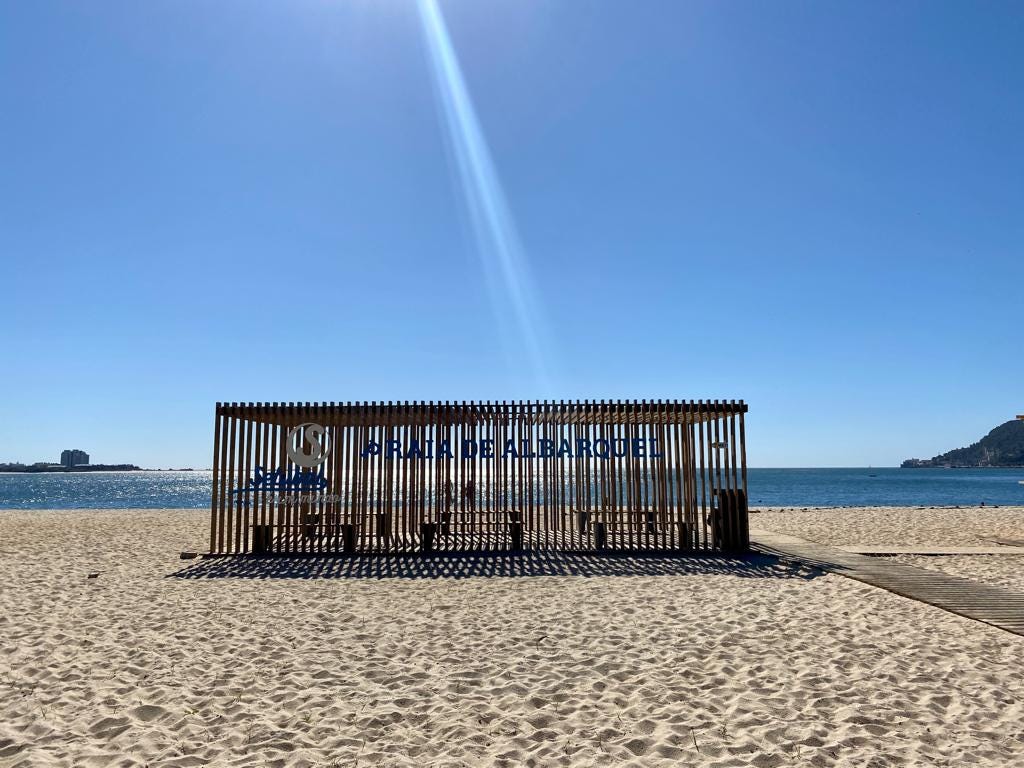
The beach buses are on, so we could just stay on this side of the river. Albarquel is pretty close, and even walkable… but the coarse sand of this man-made beach and its proximity to Setúbal is prone to attract too many unchaperoned teens and pre-teens, who think that blasting their music loudly is a sign of status. Cool. We once stood in the middle of three speakers, lost in a Bermuda triangle of Brazilian funk, where each vertex bled the same syncopated rhythm. If we had stayed longer, there’s a strong possibility that the three songs would eventually synchronize with each other, order born from chaos and whatnot, but we didn’t really care to find out and left, defeated.
We could continue contouring the mountain along the shoreline, enjoying the sights before deciding on the beach. The specters and wraiths of the Herdade da Comenda have long left. Jackie Kennedy lived in it for a while, using it as refuge after the death of her husband. Fitting then, that through the years, as its floors and ceilings crumbled, its walls were colored with the ramblings of bad LSD trips; ravers’ souls staring back at you disconcertingly through their art; empty beer bottles and wine cartons, crumpled crisp bags and loose napkins, cigarette and doobie butts, half-eaten Pingo-Doce rotisserie chickens decorating the alcoves and corners of the ruins. Years later, when the investors arrived, everything was fenced up and the building was restored to its former glory. Outside, the picnic park that once accommodated many families and weekend sardinhadas became inaccessible. After a year and four months of uproar, the people won the court case and the fences were removed. The only phantom haunting Comenda now is the threat of capitalism, as people buy it all or let it get bought: this is the price to pay for uncovering hidden gems like Setúbal.
Further along the road, the crown-jewel of the beach scene in Setúbal awaits, accessible and cost-friendly beyond the Monte Carlo-esque tunnel. Paddle boats, banana-boat rides, summer holiday kids programs, and overpriced Olá ice creams are the main attraction here. The eco campsite, the orthopedic hospital, and the cement factory are now behind us (I’m sure there’s a smart analogy involving death to be said about those three things) – and Figueirinha welcomes us with its state-of-the-art parking system. You heard me: long gone are the days of illegal parking at the lip of the mountain road, fearing enormous boulders rolling down and crushing your car; those days will be back in September when they allow the full Arrábida drive again. Until then, we can marvel at the small queues of angry drivers waiting for their spot. They won’t all make it, however. When the beach bus arrives, some of these cars must leave the queue to let the alpha vehicle park in the drop-off area, making bathers, swimmers, and sun-worshipers find parking solutions elsewhere. Ingonyama nengw’ enamabala. With buses coming every twenty minutes, you’d think what’s even the point? but a car full of people will cost only a fraction of the bus fare. We must all find our place on the path unwinding in the circle of life.
From here on out, it’s all award-winning, secluded beaches, the likes of which we haven’t seen for a while. They feel further out of reach ever since Galapinhos won that award. Only the apex buses can operate beyond Figueirinha. During the summer, those not-so-secret exclusive beach experiences are reserved for the tenacious, strong willed beach lovers. Rumor has it a Hilton is going to be built in Arrábida. One day, in the not-so-distant future, nothing will belong to us. Too bad. They’ll own nothing they can call their own either.
It’s seven now, gee, where has the day gone? so we’re heading back. Didn’t even notice it slip away. Sandy gaps and salty orifices all around, sun kissed skin rubbing against the rough seat belts. We’ve got just enough time to go home, wash the sea off our hair and crawl straight back out for some grub. We sit on the couch for just a few minutes, she’s so beautiful when she’s resting, and I feel like we could call it a day. But we’ll only be young for another three years or so, so I brainstorm some restaurant ideas and send some texts as she jumps in the priority-queue for the shower.
I usually overlook all the fish restaurants. A Setubalense that doesn’t like fish? Setúbal is an old fisherman city, built from the shoreline up, so the ancient secrets of our coveted choco frito recipe stayed in Luisa Todi avenue, but its fame spread across the country like a cuttlefish’s ink sack spraying wildly at its attacker. Oh, I love some choque frrite! some people may say, making fun of my hometown accent. While it is deliciously greasy, it’s the type of meal I usually reserve for guests.
The town’s dietary preferences have long been ruled by the iron gills of its grilled fish. Along José Mourinho avenue, flamboyant dolphin statues face a row of copy-paste restaurants, each with a more forgetful name than the last. Clinical lighting, table paper and a mustached João or Manel rushing you at every opportunity, are some of the authenticity notes to look for in these places. Since grilled fish isn’t what we look for when we go out for a meal, we usually turn to Martróia for a taste of the ocean: at the end of this avenue, a dimly lit vivarium looks over the wavy mirror beyond the promenade, almost no boats at this hour. Good quality cooking for good quality seafood; it’s hard to find better bang for your buck for a platter crowded with dead invertebrates.
Where I’d like to go but end up not going as much because I’m afraid I go too often is Delicia. Near the center of town, hidden behind a bus stop, its half-open glass door can only be seen thanks to the old-fashioned menu board, the meal images straight out of the 80s. Inside, a long counter fences off the couple who owns the joint; garrisoned over the open kitchen, a small glass of white wine nearby at all times, they sweat over the hobs to produce what might just be the best bitoque in Portugal. I’ve never once looked at the menu and have never once ordered anything different. The steak is a supporting character to the sauce, a flavor so divine it’s tempting to drink it directly from the plate.
Sweetie and me... we’re on the more exotic side of things. World foods and all. It’s too bad the Indian restaurants here aren’t as good as in England. The one we’ve got here mysteriously burned down in 2019 and reopened in a better location; the taste, however, remains as bland as it ever was. The Chinese restaurants cater for a Portuguese palate; we once ordered “Chinese beef” to try, only to discover it was a regular bitoque – maybe the cow was called Xiāng, who knows? We’re still searching all the Kebab restaurants for a half-decent donner or, hopefully, some real gyros, somewhere, anywhere, please. It’s difficult to find good quality world food when you live in a small city, in a country that’s got 365 different ways of preparing bacalhau.
Tummys packed, espressos downed, digestivos guzzled, ciggies now hanging from lower lips. It was delicious, whatever it was we had. Hard to remember now. It feels like it’s been summer forever and the days all morph into one. Throughout the year, I meet a lot of expats who can’t stop singing wonders about this city where I have lived for most of my life. It’s fun to think of how their opinion slowly molded my view of Setúbal into a gentler one. The year moves at a snail pace and then summer explodes into endless experiences that she and I get to share every day. So many new memories, friends, polaroids, drinks, foods, laughs, tears, dreams; the old ones quickly sink into the clutter. This is a slice of heaven, some of my friends have said. Maybe. I never thought about dying here, but... who knows.